
100+ Condolence Messages for Every Situation (2026)
The right condolence messages acknowledge the loss, honor the person who died, and let the grieving person know they are not alone.
The right condolence messages acknowledge the loss, honor the person who died, and let the grieving person know they are not alone. You do not need to find the perfect words. What matters most is that you reached out at all. This collection covers more than 100 original sympathy messages organized by relationship, so you can find something that fits your situation.
According to the National Funeral Directors Association, more than 2.8 million people die in the United States each year. That means millions of friends, coworkers, and family members face the same question at the same time: what do I say?
Why Are Condolence Messages So Hard to Write?
Grief sits outside the ordinary rhythms of conversation. Most of us are not trained to speak into loss, and the fear of saying the wrong thing can lead to saying nothing at all. Studies on bereavement show that social support after a death is one of the strongest predictors of healthy grieving, which means your message matters more than you think, even if it feels imperfect.
The pressure to comfort someone while also honoring the person who died is real. A good condolence message does not try to fix the pain. It says: I see your loss, I am here, and I cared about them too.
What Makes a Condolence Message Feel Genuine?
The most meaningful words of condolence are specific. A message that mentions something real about the person who died, or something true about your relationship with the grieving person, carries far more weight than a general phrase. Even one sentence of specificity changes everything.
Avoid phrases that minimize the loss, such as “everything happens for a reason” or “at least they lived a long life.” The What’s Your Grief resource on condolence language notes that these expressions, however well-intentioned, can leave bereaved people feeling dismissed. Instead, lean into acknowledgment: the loss is real, the grief is valid, and you are present.
See also: What to Say to Someone Who Is Grieving
What Are the Best Condolence Messages for the Loss of a Parent?
Losing a parent is one of the most universal losses, and yet it never feels less personal. These sympathy messages are written for someone who has lost a mother or father.
- “Your mom had a way of making every person in the room feel like the most important one there. That gift lives on in you.”
- “I keep thinking about your dad and the way he laughed. That sound is one I will carry with me.”
- “Losing a parent changes the shape of the world. I am so sorry yours has changed.”
- “Your mother was one of the most generous people I have ever known. Her kindness touched more lives than she probably realized.”
- “I know no words are enough right now. I just want you to know I am thinking of you and your whole family.”
- “Your dad was the kind of person who made you feel steady just by being in the room. His presence will be missed by so many.”
- “I am holding you in my heart today. Please let me know if there is anything I can do, big or small.”
- “Your mother raised someone remarkable. That is the truest testament to the life she lived.”
- “The love you had for your father was clear to everyone who saw you together. That love does not end here.”
- “I am so sorry for the loss of your mom. I hope the memories you carry bring you comfort in the days ahead.”
- “Your dad’s stories were the kind that stayed with you. I will always be grateful I got to hear a few of them.”
- “There is no right way to grieve losing a parent. Give yourself all the time you need, and know I am here.”
- “Your mother was exactly the kind of woman you want to have known. I feel lucky to have had that chance.”
- “Sending you so much love today. Your father deserved a beautiful send-off, and I know he got one.”
See also: In Loving Memory Quotes
What Are the Best Condolence Messages for the Loss of a Spouse or Partner?
The loss of a spouse or life partner is among the most profound a person can experience. These messages honor that bond while making space for grief.
- “The love between you two was the kind people write about. I am so sorry you are facing life without them.”
- “I can only imagine how quiet everything must feel right now. I am here whenever you need company or just someone to sit with you.”
- “Your partner was someone who made you a better version of yourself. That is a rare thing, and a real one.”
- “I will never forget how they looked at you. That kind of love leaves a mark on everyone who witnessed it.”
- “You gave each other such a beautiful life. I am so sorry this chapter has ended too soon.”
- “Please do not hesitate to reach out at any hour. Grief keeps strange hours and so do I.”
- “Your husband/wife was a pillar not just for you but for everyone around them. This loss is felt widely.”
- “I am thinking of you and your children today. You are all wrapped in so much love.”
- “Losing the person you built your life with is a grief like no other. I am so deeply sorry.”
- “Your partner had a light about them that touched everyone who got close enough to feel it.”
- “I remember the joy on your face every time you talked about them. That joy was real and earned.”
- “If you ever want to talk about them, or just talk, I am here. No agenda, just presence.”
- “I hope you feel surrounded by people who love you as much as they loved you both.”
What Are the Best Condolence Messages for the Loss of a Child?
The loss of a child is an out-of-order grief, and no message can touch the depth of it. These words of condolence aim to acknowledge the magnitude without diminishing it.
- “There are no words that reach this kind of loss. I am here, and I am so sorry.”
- “Your child was so loved. The time you had together was real and full and yours.”
- “I will always remember the way your little one laughed. That sound was pure joy.”
- “You are in my thoughts every moment. Please do not carry this alone.”
- “Your child mattered. Their life mattered. Please know that is felt beyond your family.”
- “I do not know what to say except that I love you and I am here in whatever way helps.”
- “You were the best parents, and that will always be true. Nothing changes that.”
- “The love you gave your child was evident in every story you told about them. That love was a gift.”
- “Please lean on the people around you right now. We want to hold some of this with you.”
- “Your child’s spirit touched people in ways you may not even know yet. They left a mark.”
- “I am holding you in my heart every day. You do not have to get through this alone.”
- “There is nothing I can say to ease this, but I refuse to say nothing. I see your grief and I am so sorry.”
What Are the Best Condolence Messages for the Loss of a Sibling?
Siblings share a history that no one else fully holds. These sympathy messages speak to that specific and irreplaceable bond.
- “Your brother/sister knew you before almost anyone else did. That kind of witness is irreplaceable.”
- “I am so sorry. The person who grew up alongside you is gone, and that is a loss no one else can fully understand.”
- “Your sibling was so proud of you. I heard it in the way they talked about you.”
- “Please take care of yourself right now. Grief for a sibling is its own kind of grief, and it is allowed to be hard.”
- “I cannot imagine losing my own sibling. I am here for you in whatever way feels right.”
- “Your brother/sister had a spirit that was completely their own. I will miss that spirit.”
- “The shared memories you carry are yours to keep. No loss can take those from you.”
- “I am thinking of your whole family. Losing a sibling shakes something deep.”
- “Your sister/brother loved you in a way that is clear to everyone who knew you both.”
- “If you ever want to tell stories about them, I would be honored to listen.”
- “Please reach out when the nights get hard. I mean that.”
- “I am so sorry for this loss. Your sibling was one of a kind.”
What Are the Best Condolence Messages for the Loss of a Friend?
Friendship grief is sometimes called “disenfranchised grief” because it is not always recognized the way family loss is. These messages validate the depth of that bond.
- “Losing a friend is losing someone who chose you. That grief is real and it is allowed.”
- “Your friend was one of the funniest, warmest people I have ever met. I am so grateful our lives crossed theirs.”
- “I keep thinking about all the conversations we will never get to have with them. What a loss that is.”
- “The friendship you gave each other was something rare. I hope you feel how much it mattered.”
- “Please do not minimize your own grief right now. Losing a friend is a profound loss.”
- “I am here whenever you want to talk about them or remember them out loud.”
- “Your friend was lucky to have someone who loved them as fiercely as you did.”
- “I am so sorry. Please take all the time you need, and know I am not going anywhere.”
- “They would want you to take care of yourself. Let us help you do that.”
- “Some friendships are once in a lifetime. Yours clearly was.”
- “I will remember their laugh for the rest of my life. I imagine you will too.”
- “Please reach out. Grief is lighter when it is shared.”
See also: What to Write in a Sympathy Card
What Are the Best Condolence Messages for the Loss of a Coworker?
Workplace grief is often underestimated. The loss of a colleague disrupts not just the workday but a whole web of daily connection. These messages are professional but warm.
- “I worked alongside your loved one for years, and they made every day better. They will be so missed here.”
- “The office feels different without them in it. Their presence was something we all relied on more than we realized.”
- “I am so sorry for your family’s loss. Please know that our whole team is grieving alongside you.”
- “Your colleague was one of the most dedicated, good-hearted people I have had the chance to work with.”
- “They always found a way to make a hard day lighter. That is a gift not everyone has.”
- “I hope you know how much they were valued here, not just for their work but for who they were.”
- “We will carry their contributions forward as a tribute to everything they gave this team.”
- “I am so sorry for your loss. Please do not hesitate to reach out if there is anything we can do.”
- “Their warmth and professionalism set a standard the whole team aspired to.”
- “I feel grateful every day that I got to know them. Please accept my sincere condolences.”
- “The kindness they brought to this workplace was noticed and it was valued. That kindness lives on in all of us.”
What Are Good General Condolence Messages for Any Loss?
Sometimes you need a message that works across situations, whether you did not know the person who died well, or you want to keep things simple and sincere.
- “I am so sorry for your loss. Please know you are in my thoughts.”
- “Words feel small right now, but I want you to know I care about you deeply.”
- “I am here. That is the most true thing I know how to say right now.”
- “Please lean on the people around you. You do not have to hold this alone.”
- “Sending you love and peace during a time I know is anything but peaceful.”
- “I am thinking of you and your family every day. You are not forgotten.”
- “Grief takes its own time. Give yourself as much as you need.”
- “I am so sorry. If there is anything at all I can do, please ask.”
- “Your loved one clearly meant so much to so many people. That is a beautiful legacy.”
- “I hope you feel surrounded by love today and in every day that comes after.”
- “Please take care of yourself in whatever way feels right. Nothing is expected of you right now.”
- “What to say when someone dies is one of life’s hardest questions. I am choosing to say: I love you, and I am here.”
- “The world is a smaller place without them in it. I am so sorry for this loss.”
- “You are in my heart today and every day.”
When Do Words Feel Too Small?
Sometimes a written message does not feel like enough. A card arrives, the words sit on the page, and nothing captures what you actually want to say. That is not a failure of language. It is a signal that the relationship deserved something more.
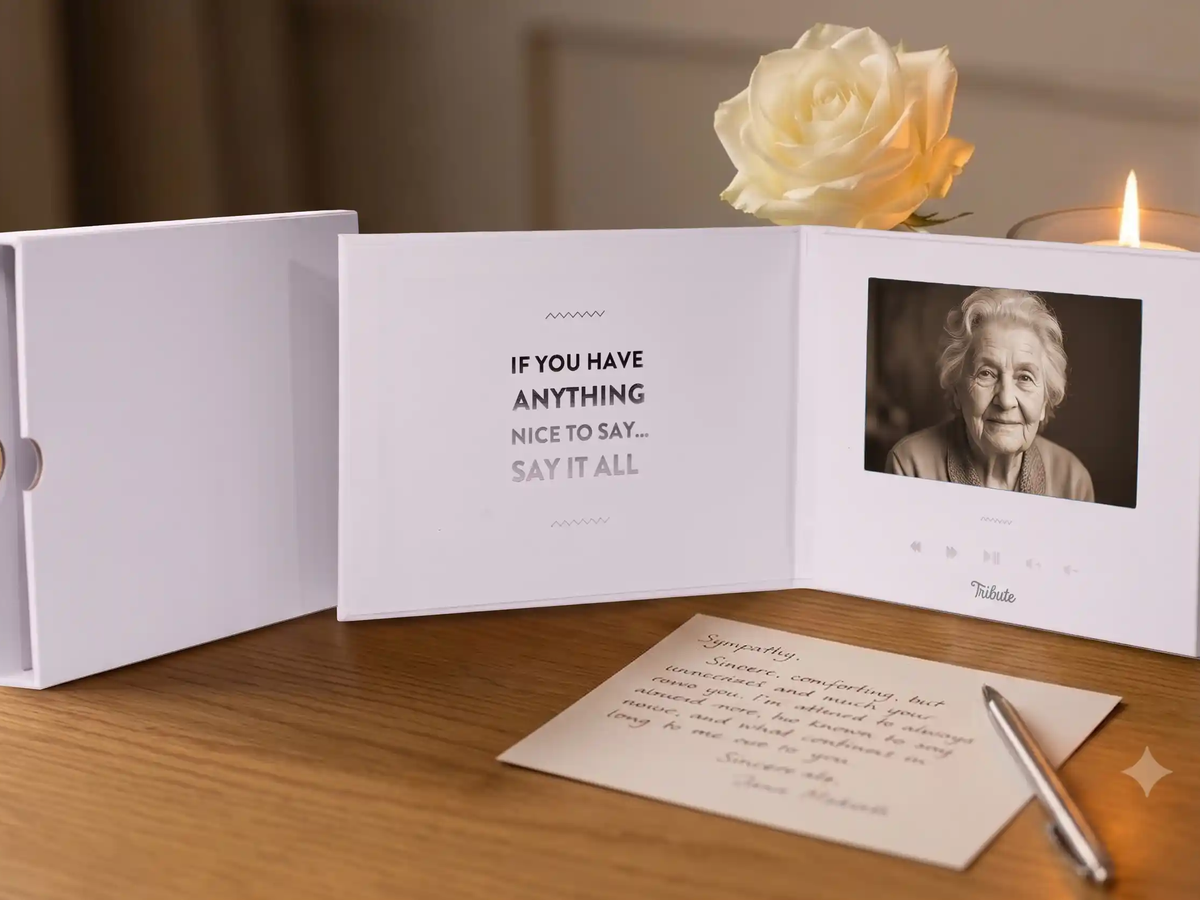
Tribute (tribute.co) is a group video gift platform that lets you collect personal video messages from friends, family, and community into a polished memorial montage. It works by sharing a link, and contributors record from any device, no app needed, and Tribute compiles everything automatically.
Unlike a single written card, a group video gathers voices from across a person’s life into one lasting memorial. Over 8 million messages have been sent through the platform, and 82% of recipients cry tears of joy. It is free to start, and digital delivery is instant.
If a written message feels too small for the size of the loss, this is one way to say it in a video instead.
👉 Record a video message for someone who is grieving
See also: How to Honor the Memory of a Loved One
What Should You Avoid Saying in a Condolence Message?
Even well-meaning words of condolence can land wrong. The Emily Post Institute notes that certain common phrases, while said with care, can feel minimizing to someone in acute grief. Avoid these:
- “Everything happens for a reason”
- “At least they are in a better place”
- “I know how you feel”
- “At least they lived a long life”
- “Time heals all wounds”
- “You need to be strong for the kids”
- “Let me know if you need anything” (without following through)
Replace these with specificity and presence. Say what you remember about the person. Offer a concrete gesture. Acknowledge that the loss is real. That is enough.
How Long Should a Condolence Message Be?
Most sympathy messages work best at two to five sentences. Long enough to show care, short enough to be read in a moment of grief when concentration is difficult. A message does not need to be long to be meaningful. It needs to be true.
If you are writing for a card, aim for three to four sentences. If you are writing an email or letter, you can extend to a paragraph or two. If you are leaving a comment online, one or two sentences are enough.
Frequently Asked Questions About Condolence Messages
What is a condolence message?
A condolence message is a written or spoken expression of sympathy sent to someone who has experienced a loss. It acknowledges the death, offers support, and lets the grieving person know they are not alone. Condolence messages can be sent by card, email, text, or in person.
What are the best words of condolence?
The best words of condolence are specific, honest, and free of clichés. Mentioning something real about the person who died, or about your relationship with the grieving person, makes the message feel genuine. Simple acknowledgment, “I am so sorry for your loss, I am here,” is always appropriate.
What do you say when someone dies unexpectedly?
When a death is sudden or unexpected, the shock compounds the grief. Start by acknowledging the shock directly: “I cannot believe this happened. I am so, so sorry.” Avoid trying to make sense of the loss. Focus on presence and support instead.
Is it okay to text a condolence message?
Yes. A text message is better than silence. If the relationship is close, follow up with a card or call. If you are not close to the person, a sincere text is a kind and appropriate gesture. What matters is that you reached out.
How do you write a condolence message to a coworker?
Keep the tone warm but not overly personal if you did not know the family. Acknowledge the loss, express that the person was valued by the team, and offer support. Avoid sharing opinions about workplace decisions like time off or coverage. Focus entirely on the human side.
What is the difference between condolences and sympathy?
The terms are often used interchangeably. “Condolences” tends to be slightly more formal, while “sympathy” is broader and can include emotional sharing of grief. Both are appropriate in most situations. What matters more than the word choice is the sincerity behind it.
How do you respond when someone sends condolences?
You do not have to respond immediately. When you do, a simple “thank you for your kind words” is enough. You are not obligated to reassure the person who reached out. Your only job right now is to grieve.
Can you send condolence messages on social media?
Yes, especially if the family has announced the death publicly. Keep the message brief and sincere. Avoid long personal stories in public threads. If you want to say more, send a private message or a card.
What Is the Most Important Thing a Condolence Message Can Do?
The most important thing any sympathy message can do is make the grieving person feel less alone. Loss is isolating. Hearing from people who cared, even in a short note, cuts through that isolation in a way that nothing else quite can.
A card is different from a phone call, which is different from showing up at the door with food, which is different from a video of fifteen people saying your loved one’s name with tears in their eyes. None of these is the wrong choice. Each one says: you matter, they mattered, and we are here.
If you want to go beyond words on a page, consider gathering voices together into something lasting.


