
Memory Table Ideas for a Funeral or Celebration of Life (2026)
A memory table is a dedicated display at a memorial, funeral, or celebration of life that gathers photographs, objects, and mementos representing the person who died.
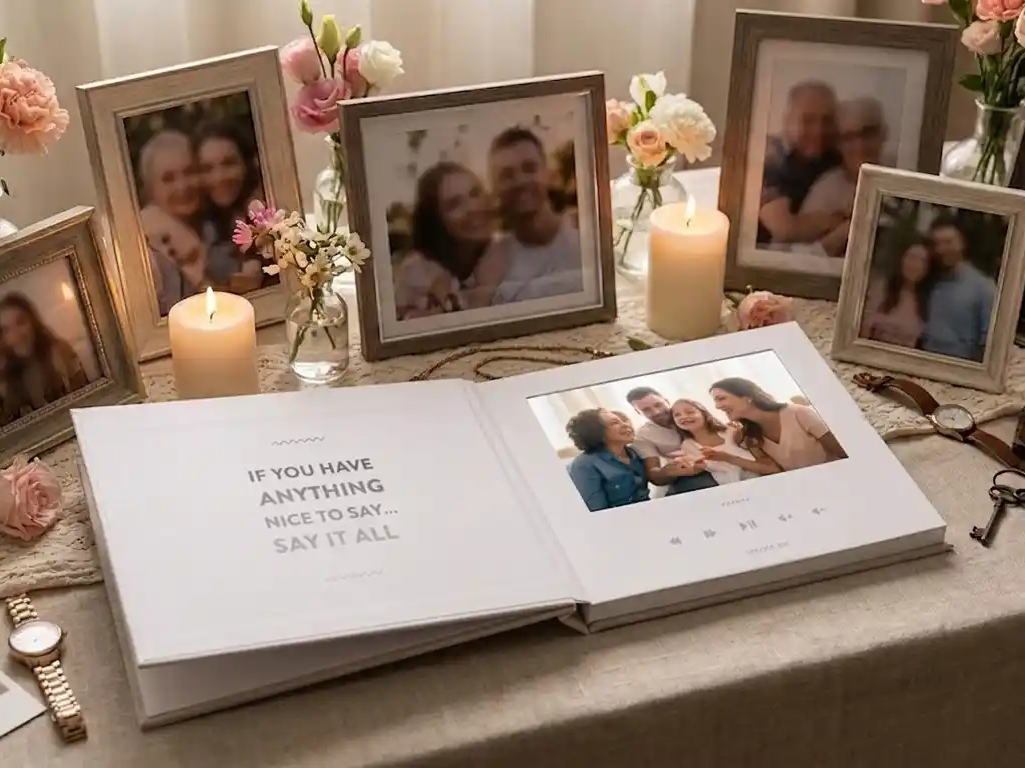
A memory table is a dedicated display at a memorial, funeral, or celebration of life that gathers photographs, objects, and mementos representing the person who died. It gives guests a place to pause, look, remember, and feel close to the person. The best memory tables combine a few categories of items: photos across time, objects the person touched, and something living and moving, like a looping video tribute, at the center. This guide gives you 20 specific memorial table ideas you can use as-is or combine.
What Is a Memory Table at a Memorial or Funeral?
A remembrance table, also called a memory table or memorial table, is a display set up at the service or reception. It serves as a gathering point for guests who want to feel connected to the person who died without having to speak. Research from the Hospice Foundation of America suggests that meaningful objects and shared sensory experiences help mourners process grief and feel less alone. A well-curated memory table does both.
A memory table differs from a simple photo display in that it is three-dimensional and multi-sensory. It includes objects the person touched, scents they loved, things that reflect their personality, and ideally something that moves, speaks, or plays. Compared to a static display, a table with a looping video tribute creates a gathering point rather than a passing glance.
What Do You Put on a Memory Table?
A strong memory table draws from several categories: photographs, personal objects, sensory elements (candles, flowers), and interactive or moving elements (video, guest books). The 20 ideas below cover each category with practical setup guidance.
What Are the Best Memory Table Ideas?
1. Tiered Photo Display
Best for: Any memory table. Works as the foundation for nearly every other idea in this list.
Why it works: Photographs arranged at varying heights draw the eye and invite guests to move along the display rather than seeing everything from a single point. Use small stands, stacked books, or a tiered shelf to create levels.
2. Timeline Photo Strand
Best for: Celebrating a long life with many chapters, or honoring someone whose different life phases were distinct and well-documented.
Why it works: A photo strand strung chronologically from childhood to the recent past walks guests through a life visually. Clothespins on twine or ribbon is the simplest method. Label each cluster of photos with a decade or life stage.
3. Favorite Book Stack
Best for: Readers, teachers, academics, or anyone who had a deeply personal relationship with books.
Why it works: A person’s books are a portrait of their interior life. Stacked on the table with a small label that reads “books [Name] loved,” they invite guests to pick up and look, which starts conversations and stories.
4. Handwriting Display
Best for: Anyone whose handwriting was recognizable and personal. Works especially well if letters, recipe cards, or notes can be found.
Why it works: Handwriting is irreplaceable. A framed note, a recipe card, or a scanned letter in the person’s own hand is one of the most immediate and visceral items you can display. Many guests find it more moving than a formal photo.
5. Recipe and Food Table
Best for: Someone whose love was expressed through cooking, whose kitchen was the center of family life, or whose signature dish is known by everyone.
Why it works: Food connects memory to the body. Displaying handwritten recipe cards beside a dish made from those recipes lets guests taste the person’s presence.
6. Military or Service Honors
Best for: Veterans, first responders, volunteers, and anyone who served in a formal capacity and was proud of that service.
Why it works: Medals, badges, photographs in uniform, and official documents are concrete evidence of a life of service. A flag display case, if applicable, becomes a centerpiece with immediate weight and meaning.
7. Hobby and Collections Display
Best for: Anyone with a passionate hobby or collection. Works for gardeners, woodworkers, anglers, golfers, painters, coin collectors, birdwatchers, and more.
Why it works: A person’s hobby tells guests how they spent their most alive hours. Displaying the objects of that hobby, a lure, a brush, a hand tool, a chess set, gives guests something specific to ask about and remember.
8. Children’s or Grandchildren’s Drawings
Best for: Grandparents, parents, teachers, or anyone who was beloved by children and who saved their artwork.
Why it works: A grandparent who kept every drawing a grandchild ever made has said something profound about their priorities. Displaying those drawings alongside recent photos creates an arc that spans generations and causes many guests to cry.
9. Map and Travel Display
Best for: A traveler, someone who lived in many places, or a person who explored the world and talked about it constantly.
Why it works: A pinned map showing everywhere the person went invites guests to add their own pins for places they traveled together. It is interactive, personal, and creates stories on the spot.
10. Music Playlist Card
Best for: Someone who was known for their musical taste, who always had music playing, or whose identity was tied to a particular era or artist.
Why it works: A printed card listing “Songs [Name] Loved” beside a small speaker playing that playlist turns the memory table into a sensory experience. Guests who walk past will hear the person before they see the photos.
11. Candle and Flower Arrangement
Best for: Any memorial table, used as a grounding element around which other objects are grouped.
Why it works: Soft candlelight and fresh flowers create warmth and draw guests to approach. White candles and the person’s favorite flower are the simplest combination. If open flames are not allowed in the venue, LED candles work well.
12. Guest Memory Cards
Best for: Any gathering where you want guests to contribute something and leave with a sense of participation.
Why it works: Small cards with the prompt “A memory I have of [Name] is…” invite guests to write something and either leave it on the table or drop it in a jar. Families often read these aloud at a later gathering or keep them as a keepsake collection.
13. Their Chair
Best for: Someone who had a known, beloved chair: a rocking chair, a recliner, a porch chair. Works especially well for informal or home-based gatherings.
Why it works: An empty chair with the person’s sweater or hat draped over it and a small photo propped against it is one of the most immediately emotional displays possible. It says: this is where they sat. This is the space they left.
14. Awards and Accomplishments Wall
Best for: Someone whose professional or community achievements were central to their identity and source of pride.
Why it works: Diplomas, certificates, plaques, ribbons, and newspaper clippings tell a story of effort and recognition. Guests who did not know the person well learn who they were. Guests who knew them well find confirmation of what they already knew.
15. Scrapbook or Photo Album on Display
Best for: A person who documented their own life, or a family that wants to give guests something to sit down with and look through.
Why it works: A scrapbook set open on the table invites guests to turn pages. It creates a natural sitting area and a gathering point for longer conversations.
16. Tribute Video Book as Centerpiece
Best for: Any memorial where guests include people who could not attend in person, or where the family has gathered video messages from a large community.
Why it works: A Tribute Video Book is a linen-bound hardback with a built-in 7-inch screen that plays automatically and loops. Placed at the center of the memory table, it becomes the living heart of the display, showing the faces and voices of everyone who contributed a message. Guests gather around it, watch together, and often share the messages it plays.
Tribute (tribute.co) is a group video gift platform that lets you collect personal video messages from friends, family, and community into a polished memorial montage. It works by sharing a link, contributors record from any device, no app needed, and Tribute compiles everything automatically. It is free to start, requires no app, and carries no watermark. More than 8 million messages have been sent through the platform.
👉 Create a looping video tribute for the memory table centerpiece
17. Favorite Scent
Best for: Anyone associated with a particular scent: a gardener with roses, a baker with vanilla, a person who wore the same cologne for 40 years.
Why it works: Scent is the most direct route to memory in the human brain. A candle, diffuser, or small arrangement in their signature scent can trigger recognition and emotion before a guest has even focused their eyes on the table.
18. Video or Slideshow Screen
Best for: Larger gatherings with access to a monitor or television near the memory table area.
Why it works: A looping slideshow or video tribute playing on a screen adjacent to the memory table creates a dynamic, evolving display. It shows the person in motion, in conversation, in laughter. Still photos tell part of the story. Video tells the rest.
19. Memory Jar or Box
Best for: Any gathering where guests include people who knew the person in different contexts: school, work, community, neighborhood.
Why it works: A glass jar or open box with folded memory slips accumulates over the course of the gathering and becomes a physical representation of how many people the person touched. Families often read the slips together on the evening after the service.
20. The Thing They Always Carried
Best for: Anyone known for an object they always had with them: a pocket watch, a rosary, a particular hat, reading glasses, a worn wallet, a pocket knife.
Why it works: The object a person always carried is one of the most intimate things they owned. Displayed under a small glass dome or on a velvet cloth, it becomes the most personal item on the table. Guests who knew the person will recognize it immediately, and that recognition is its own kind of testimony.
How Do You Set Up a Memory Table?
Start with a stable table in a high-traffic area, near the entrance or in the main reception room, where guests will naturally pass or gather. Cover it with a cloth in a color that suits the person: linen for something quiet and classic, a favorite color for something more personal.
Build in layers: anchor elements at the back and center (large frames, a screen, the video book), medium elements in the middle (books, objects, candles), and small details at the front (cards, small frames, loose flowers). Leave space between items so each one can be seen and appreciated.
Add a simple hand-lettered sign at the front of the table with the person’s name and dates. It grounds the display and tells guests arriving for the first time exactly whose memory they are in the presence of.
For more ideas on how to personalize the gathering around the person’s passions, see our guide on celebration of life themes. For the full event-planning picture, see memorial service ideas and our roundup of memorial keepsake ideas for items guests can take home. For longer-term ways to carry the person forward beyond the service, see how to honor the memory of a loved one.
Frequently Asked Questions
- What is a memory table at a funeral?
- A memory table is a display set up at a funeral, memorial, or celebration of life that gathers photographs, personal objects, and mementos representing the person who died. It gives guests a place to pause, look, and feel connected to the person.
- What should you put on a memory table?
- Good memory tables include photographs across different life stages, personal objects related to their hobbies or work, handwritten notes or recipe cards, candles and flowers, and a looping video tribute at the center. The best items are specific to the person rather than generic.
- How do you make a memory table for a funeral?
- Choose a stable table in a high-traffic area. Cover it with a cloth. Layer items from back to front: large anchors at the back, medium objects in the middle, small details at the front. Place the most meaningful item at the center. Add a small sign with the person’s name and dates.
- What is the difference between a memory table and a photo display?
- A photo display is two-dimensional and typically mounted on a wall or board. A memory table is three-dimensional and multi-sensory, including objects, candles, interactive elements, and potentially a looping video tribute. A memory table creates a gathering point; a photo display creates a viewing moment.
- Can you use a tablet or screen at a memory table?
- Yes. A tablet or dedicated device running a looping video tribute or photo slideshow is one of the most effective memory table centerpieces. The Tribute Video Book is a linen-bound hardback with a built-in screen that plays and loops automatically, designed specifically for this purpose.
- How early should you set up a memory table?
- Set up the memory table before guests arrive, ideally an hour before the service or reception begins. This gives you time to adjust the arrangement, ensure any technology is working, and step back to see the display as guests will see it.


