
Celebration of Life Ideas: How to Plan a Meaningful Service (2026)
A celebration of life is a gathering that centers on who your loved one was, not just the fact that they are gone.
A celebration of life is a gathering that centers on who your loved one was, not just the fact that they are gone. These 35 memorial ideas span activities, memory-capture, readings, decor, food, and digital video so every family can find something that fits. Whether you have a week to plan or a single afternoon, there is a way to honor a loved one that will feel true to them.
What Makes a Celebration of Life Different from a Traditional Funeral?
A traditional funeral follows a set religious or cultural format, with the body present and the service structured around mourning. A celebration of life puts the emphasis on memory, story, and the specific person who lived. According to the National Funeral Directors Association (NFDA), personalized memorial services have grown year over year as families look for gatherings that reflect a loved one’s character rather than a standard ceremony.
The event can be held anywhere, at any time, weeks or even months after the death. It can be casual or formal, religious or secular, small or open to an entire community. The only rule is that it reflects the person being remembered.
See also: What Is a Celebration of Life
How Do You Start Planning Celebration of Life Activities?
Begin with three questions: Who was this person? Who loved them? What would they have wanted? The answers will guide every decision, from the venue to the music to the ways to honor a loved one that feel right for your family.
Give yourself permission to keep it simple. A meaningful gathering does not require a large budget or professional event coordination. Many of the most remembered celebrations happen in living rooms and backyards.
See also: How to Plan a Celebration of Life
Which Ideas Work Best for Collecting and Sharing Memories?
1. Collect a Group Video Tribute
Invite everyone who loved your person to record a short video message. A family in Ohio gathered 40 messages from their mother’s book club, former students, and childhood friends, all without anyone having to travel. The result was a montage that played at the service and then lived on the family’s shelf for years.
Best for: Families whose community is spread across multiple cities or countries, or where not everyone can attend in person.
Why it works: Video captures the voice, the laugh, the specific story that a written card never could. Over 8 million video messages have been sent through Tribute, and 82% of recipients cry tears of joy when they watch them.
Tribute (tribute.co) is a group video gift platform that lets you collect personal video messages from friends, family, and community into a polished memorial montage. It works by sharing a link, contributors record from any device, no app needed, and Tribute compiles everything automatically.
👉 Start a free group video tribute for your loved one
2. Memory Jar or Box
Place a large glass jar and small cards at the entrance. Ask guests to write one memory, one word that described your loved one, or one thing they learned from them. Read them aloud at the gathering or take them home as a keepsake.
Best for: All ages, including children who may not know how to express grief but can write a single word or draw a small picture.
Why it works: The act of writing a memory is itself a small grief ritual. The jar becomes a physical object the family can return to over months and years.
3. Memory Table with Curated Objects
Set a table with items that defined your loved one’s life: a favorite book, a worn tool, a sports jersey, a recipe card in their handwriting. Small labels can explain each object’s meaning for guests who didn’t know that chapter of their life.
Best for: Gatherings where guests span different eras of the person’s life and may not know each other’s stories.
Why it works: Objects ground memory in something tangible. They invite strangers to become storytellers by saying “Oh, I remember when they used that.”
4. Digital Photo Wall
Loop a slideshow of photos on a large TV or projector screen throughout the gathering. Use a free tool like Google Photos or a dedicated memorial app to compile images from multiple family members in advance.
Best for: Venues where a focal display point is available and guests will be moving around the room rather than sitting in rows.
Why it works: Ambient visuals keep the person’s presence felt without demanding everyone stop and watch at the same moment.
5. Signed Memory Book or Guestbook
Provide a linen or leather guestbook where guests write a note, paste a printed photo, or leave a handprint. Unlike a standard funeral register, this book is designed to be read and kept.
Best for: Any celebration of life, but especially gatherings where guests may include people the immediate family has not met.
Why it works: It extends the experience beyond the day. Families often report reading these books repeatedly in the months after a loss.
What Activities Can Guests Participate in Together?
6. Open Mic Storytelling
Set up a microphone and invite guests to share a two-minute story. Assign a gentle timekeeper and a trusted emcee who can bridge awkward silences. The stories that come out of an open mic are almost always the ones families remember most.
Best for: Gatherings of 20 or more people where many guests have distinct relationships with the deceased.
Why it works: Stories create shared ownership of grief. They also introduce facets of a person’s life that even close family members may not have known.
7. Memory Walk or Nature Hike
If your loved one had a favorite trail, park, or waterway, organize a walk there. You can scatter wildflower seeds, release biodegradable balloons, or simply walk in silence. The Hospice Foundation of America recognizes outdoor rituals as meaningful for grief processing.
Best for: People who loved the outdoors, or families who want to keep the event physically active and not confined to a room.
Why it works: Movement releases emotion. Walking together creates natural one-on-one conversations that a seated service rarely allows.
8. Candle Lighting Ceremony
Begin or close the gathering with a single candle lit by an immediate family member. Each guest then lights their own smaller candle from the first, until the room is filled with light. A short reading or moment of silence accompanies each lighting.
Best for: Evening gatherings or services in dim spaces where the visual effect is most powerful.
Why it works: The image of one light becoming many is a simple and cross-cultural symbol of how one life touches others.
9. Planting a Memorial Tree or Garden
Order a sapling or seed kit in advance. Guests can each add a small handful of soil to the planting during the gathering. Choose a tree species your loved one admired or one native to the region where they lived.
Best for: Families with access to a yard, garden, or park where a permanent planting is possible.
Why it works: A living memorial grows over time. It gives the family a place to return to on anniversaries and difficult days.
10. Letter Writing Station
Set up a table with stationery, envelopes, and stamps. Ask guests to write a letter to the deceased, to a family member, or to their future self. Collect the unsealed letters and bind them in a keepsake folder for the family.
Best for: Guests who are introverted or find spoken words difficult, and for gatherings that want a quiet activity corner alongside louder socializing.
Why it works: Writing slows grief down. It transforms a chaotic emotional state into something concrete and communicable.
What Are the Best Decoration and Display Ideas?
11. Themed Decor Reflecting Their Passions
If your loved one was a gardener, fill the room with potted herbs and seed packets guests can take home. If they loved baseball, use pennants, scorecards, and stadium-style popcorn buckets. Connecting decor to their actual life makes the space feel inhabited by them.
Best for: Anyone with a strong personal interest, hobby, or identity that defined their life.
Why it works: Themed decor communicates “this was a specific person” rather than a generic memorial setting.
See also: Celebration of Life Themes
12. Timeline Photo Display
String a clothesline or mount a foam board with photos arranged chronologically from childhood to recent years. Label each era with a small handwritten card. This creates a visual biography guests can walk through at their own pace.
Best for: Gatherings that include people who knew the person at different stages of life and who want to see the full arc.
Why it works: A timeline makes visible the breadth of a life. It often prompts guests to recognize themselves in a photo or recognize someone they haven’t seen in decades.
13. Flower Wall or Bloom Bar
Set up a low table with seasonal flowers, greenery, and small vases. Guests can build their own small arrangement to take home as a favor. Use the deceased’s favorite flowers or colors as the palette.
Best for: People who loved flowers, gardening, or hosting, and for gatherings where you want guests to have something hands-on to do.
Why it works: The act of making something beautiful is a quiet act of tribute. Guests leave with a personal memento rather than a printed program they may not keep.
14. Chalkboard Memory Wall
Paint or rent a large chalkboard panel. Write a prompt at the top: “What I will always remember is…” or “The way you made me feel was…” Guests add responses throughout the event, building a collective portrait.
Best for: Informal celebrations with a casual venue and a community comfortable with public expression.
Why it works: The wall becomes a collective artwork. Photograph it before the event ends so the family has a permanent record.
15. Tribute Video Book on Display
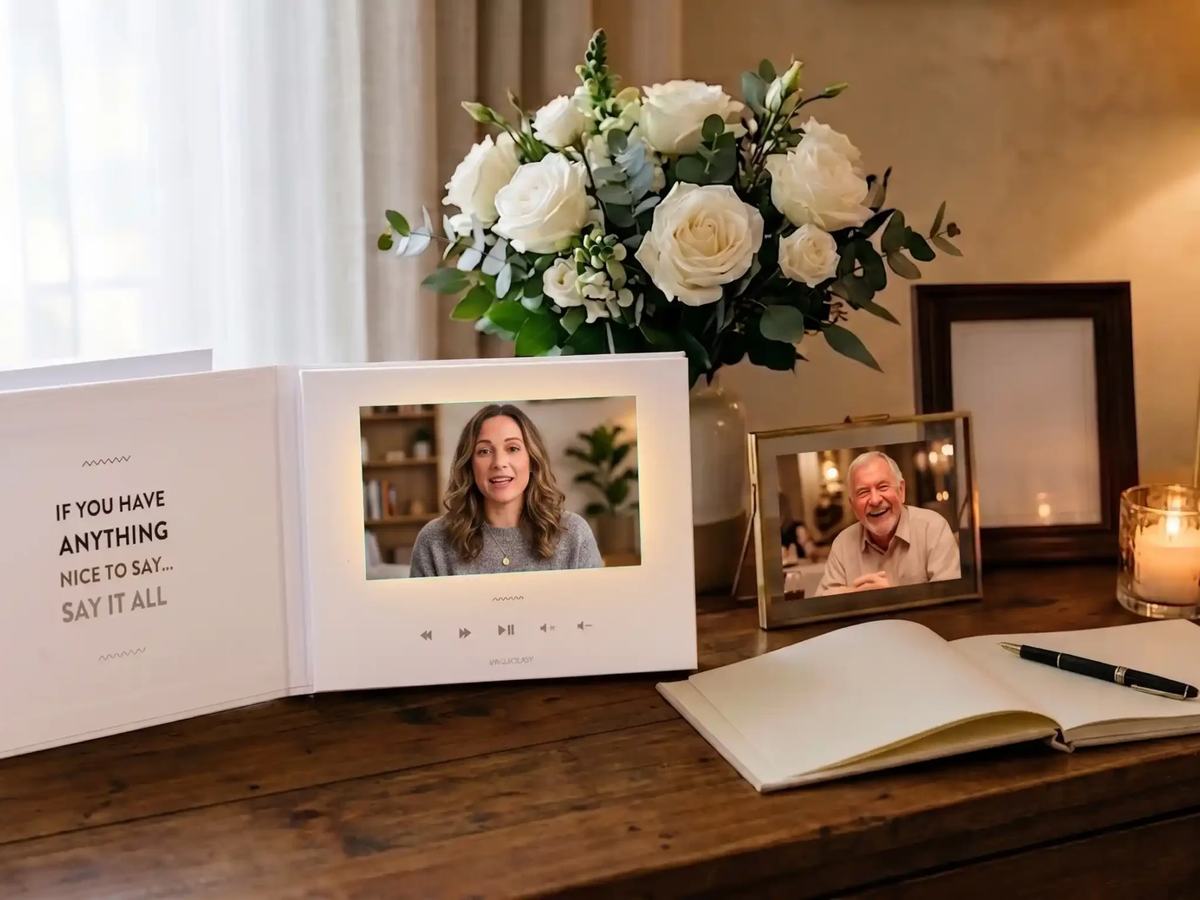
The Tribute Video Book is a linen-bound hardback that opens to a 7-inch screen with built-in speakers. The memorial montage plays automatically when the cover opens. Place it on the memory table or pass it among guests, and it becomes both a display item during the service and a lasting keepsake for the mantel afterward.
Best for: Families who want the group video tribute to have a physical home beyond a digital file.
Why it works: Unlike a framed photo or a printed program, the Video Book plays the actual voices and stories of everyone who loved them.
What Readings and Words Help Carry the Service?
16. Readings from Their Favorite Books or Poems
Ask family members to select one short passage your loved one returned to often, a dog-eared page, a marked verse, a line they quoted at the table. Multiple readers can each offer one passage, building a literary portrait of the person.
Best for: People who were readers, writers, or who found comfort in literature or scripture.
Why it works: Words they chose in life carry extra weight when read aloud in their memory. It is a way of letting them speak.
17. Eulogy from an Unexpected Person
In addition to immediate family, ask someone from outside the inner circle: a neighbor, a former colleague, a childhood friend who reconnected later. The unexpected perspective almost always reveals something the family did not know.
Best for: Any gathering where the family wants to honor the reach of their loved one’s impact beyond the home.
Why it works: It validates how widely the person mattered. It also gives less prominent mourners a formal role in the service.
18. A Letter Read Aloud
If your loved one left letters, notes, or even a voice message, consider reading it or playing it at the service. With care and consent from immediate family, this can be one of the most powerful moments in the entire gathering.
Best for: Families where the deceased was articulate and left written or recorded words behind.
Why it works: Hearing their own words, or the closest approximation, makes the presence immediate in a room full of grief.
19. Community Blessing or Affirmation
Ask guests to speak a single word or short phrase in unison: a value the person embodied, a quality they want to carry forward. The collective voice creates a moment of unity that crosses religious and cultural backgrounds.
Best for: Diverse gatherings where a single religious framework does not fit everyone present.
Why it works: It gives everyone a role without requiring a speech. The sound of many voices speaking together is itself a form of tribute.
What Food and Drink Ideas Honor a Loved One’s Memory?
20. Their Signature Recipe
Cook or bake the dish your loved one was known for and place it at the center of the food table. Print the recipe on a card so guests can take it home. Food is one of the most immediate sensory pathways to memory.
Best for: Anyone who cooked, baked, or had a dish they were associated with across family gatherings for decades.
Why it works: Taste and smell bypass language entirely. Guests will feel the person’s presence in a way no words can replicate.
21. Potluck Memorial Meal
Ask each attending family or friend to bring a dish connected to a shared memory: the pasta you always had at their house, the pie they made every Thanksgiving. Label each dish with the contributor’s name and the memory it carries.
Best for: Close communities where guests know the family well and are comfortable contributing.
Why it works: A potluck distributes the labor of care. It also generates conversation as guests explain their chosen dishes to each other.
22. A Toast with Their Favorite Drink
Whether it was coffee, sweet tea, or a specific cocktail, pour everyone the same thing and offer a short toast. Nonalcoholic versions should always be available for all ages and preferences.
Best for: Any gathering, but especially those that want a clear communal ritual without religious framework.
Why it works: The shared act of raising a glass at the same moment creates solidarity. It marks the transition from the hardest part of grief to the celebration of what was good.
23. Recipe Card Favors
Print three or four of your loved one’s most-loved recipes on small cards tied with twine. Stack them at the exit for guests to take as a favor. These cards often become the most cherished tangible keepsake from the service.
Best for: Anyone who cooked regularly or whose kitchen was a gathering place for family and friends.
Why it works: A recipe is an instruction for continuing a tradition. It gives the family a way to keep cooking together in their loved one’s spirit.
What Digital and Video Ideas Work Best for Memorial Gatherings?
24. Live Stream for Remote Guests
Use a phone on a tripod and a free platform like YouTube Live to stream the service for guests who cannot attend. Assign one person as the remote host to monitor comments and relay messages into the room.
Best for: Geographically dispersed families, elderly guests who cannot travel, or international communities.
Why it works: Exclusion from a memorial is its own form of grief. A live stream removes the barrier of distance so more people can be part of the day.
25. A Memorial Hashtag and Photo Album
Create a private social media group or shared cloud album and ask guests to upload their personal photos before and after the event. Unlike a single family’s collection, this gathers images across decades and perspectives.
Best for: Tech-comfortable communities and families who want a collaborative digital archive.
Why it works: Guests often have photos the immediate family has never seen. The album becomes a discovery as much as a collection.
26. Video Messages from Those Who Cannot Attend
Ask friends and family who cannot travel to record a short video message before the event. Play the collection during the service or set up a device in a quiet corner where guests can watch individually.
Best for: Any gathering with a significant portion of the community living elsewhere.
Why it works: A face and a voice carry emotional weight that a written card does not. Hearing someone say “I loved them because…” is an irreplaceable form of tribute.
Unlike a slideshow of photos alone, a collaborative video tribute includes the voices and stories of the entire community. Unlike a single-speaker eulogy, a group video lets 15, 30, or 50 people each share what only they knew.
👉 Collect video messages from everyone who loved them
27. A Memorial Website or Online Obituary
Free platforms like Ever Loved or GatheringUs let families create a memorial page where guests can leave condolences, share photos, and find service details. The page stays active after the gathering as a long-term tribute space.
Best for: Families who want a permanent public space for extended community, colleagues, and acquaintances to leave their respects.
Why it works: The immediate circle is rarely the full extent of a person’s impact. An online memorial gives everyone a place, including those who found out too late to attend.
28. A Donated Playlist of Their Favorite Songs
Ask friends and family to submit one song each that reminds them of your loved one. Compile the submissions into a shared playlist and play it as background music throughout the event. Share the playlist link with guests afterward.
Best for: People whose relationship with music was central to who they were.
Why it works: Music activates memory faster than almost any other stimulus. A collaborative playlist also distributes the emotional labor of curation across many people rather than one grieving organizer.
What Are Additional Ways to Honor a Loved One Through Service and Legacy?
29. A Charitable Donation Drive
Choose a cause your loved one cared about and invite guests to contribute in lieu of flowers. Display a running total during the event. Announce the final amount as a closing moment in the service.
Best for: Families whose loved one had a known cause, charity, or advocacy commitment.
Why it works: Directing grief into action is a recognized coping mechanism. It also creates a tangible legacy in the world beyond the gathering itself.
See also: How to Honor the Memory of a Loved One
30. A Scholarship or Memorial Fund
If the family is open to a longer-term effort, a small scholarship at a school, club, or community organization can carry a name forward for years. Many local organizations are willing to establish named awards for as little as a few hundred dollars.
Best for: Educators, mentors, coaches, and community leaders whose influence extended to young people.
Why it works: A scholarship multiplies the impact of a life. Each recipient carries the name and story forward into their own future.
31. Volunteer Together in Their Name
Organize a group volunteer session at a place your loved one supported, a food bank, an animal shelter, a community garden. Schedule it for one month after the service when the initial wave of support from others often fades.
Best for: Tight communities who want to stay connected to each other and to the person’s memory after the formal gathering ends.
Why it works: Resources from What’s Your Grief consistently note that purposeful action is one of the most healthy responses to loss. Volunteering together channels that impulse as a group.
32. Create a Recipe Book or Memory Book
Collect recipes, photos, and short stories from family and friends into a printed book. Services like Shutterfly or Chatbooks make small-run printing affordable. Each family member receives a copy as a lasting keepsake.
Best for: Families who want a tangible, holdable record of the person’s life beyond a digital archive.
Why it works: A printed book has a physicality that digital files do not. It can be passed across generations, left on a coffee table, and returned to without a password or a device.
33. Commission a Piece of Art or Music
Work with a local artist, musician, or poet to create something original in your loved one’s memory. It does not need to be expensive: a hand-lettered quote, a short instrumental piece, or a watercolor of a meaningful place all qualify.
Best for: Families connected to creative communities, or for honoring a person who was an artist, musician, or writer themselves.
Why it works: Art made in someone’s memory is an act of translation. It takes private grief and gives it a form that others can experience.
34. A Celebration of Life Trip
For close families willing to plan ahead, a trip to a place that mattered deeply to your loved one can serve as a memorial gathering in itself. Spread ashes, plant a stone, or simply share a meal in a place they loved.
Best for: Small families or friend groups who shared travel with the deceased and want a more intimate gathering than a large public service.
Why it works: Place carries memory. Being somewhere they were changes how you feel about the loss in ways that a room arranged with flowers cannot.
35. An Annual Remembrance Gathering
Commit to gathering on the birthday, the anniversary, or another meaningful date each year. Keep it informal: a shared meal, a walk, a video watch party of the memorial montage. The ritual itself becomes part of how the family holds the loss.
Best for: Any family, but especially those whose grief is extended or whose community is tight enough to sustain annual connection.
Why it works: Grief does not end after the service. A recurring gathering creates a container for the ongoing relationship with loss that most people carry for years.
Frequently Asked Questions About Celebration of Life Ideas
What is the difference between a celebration of life and a memorial service?
A memorial service typically follows traditional religious or cultural formats and focuses on mourning. A celebration of life is more flexible, puts emphasis on the person’s character and story, and can happen weeks or months after the death. Both are valid, and many families combine elements of both.
How long should a celebration of life last?
Most celebrations of life run between one and three hours. Shorter events can feel rushed if many people want to speak; longer events can exhaust grieving guests. A two-hour window with a loose schedule tends to give space for both structured moments and informal conversation.
Does a celebration of life have to be religious?
No. A celebration of life can be entirely secular, religious, spiritual, or some blend of all three. The goal is to reflect the person who lived, which means the format should match their beliefs and the comfort of those attending.
How do you involve children in a celebration of life?
Children can draw a picture, write or dictate one memory, participate in a planting activity, or simply be present. Give them a small, concrete role rather than asking them to manage open-ended emotion. A memory jar with drawing-sized cards works well for very young children.
Can a celebration of life be held outdoors?
Yes, and for many people it is a preferred option. Parks, gardens, beaches, and backyards all make meaningful venues. Plan for weather contingencies, especially with elderly guests, and check local permit requirements if you expect a large group in a public space.
What should guests wear to a celebration of life?
The invitation should guide guests. Many families now request colors the deceased loved rather than black. If the person had a signature color or a beloved sports team, wearing those colors is a natural tribute. The most important thing is that guests feel welcomed, not judged.
How do you collect video messages from people who cannot attend?
The simplest approach is to share a link through a platform like Tribute, where contributors record from any device, no app required, and messages are gathered in one place. Automatic reminders help collect videos even during a hard week when people forget or hesitate. Unlike a group text chain or email thread, a dedicated platform keeps everything organized and editable before the service.
How far in advance should you plan a celebration of life?
Because a celebration of life does not require the body to be present, families often wait two to six weeks after the death to allow out-of-town guests to make travel arrangements. Some families plan a small immediate gathering and then a larger celebration weeks later. There is no right timeline; choose what gives the most people a chance to be present.


