
Mennonite Wedding Videos: What to Ask Before You Record Anything
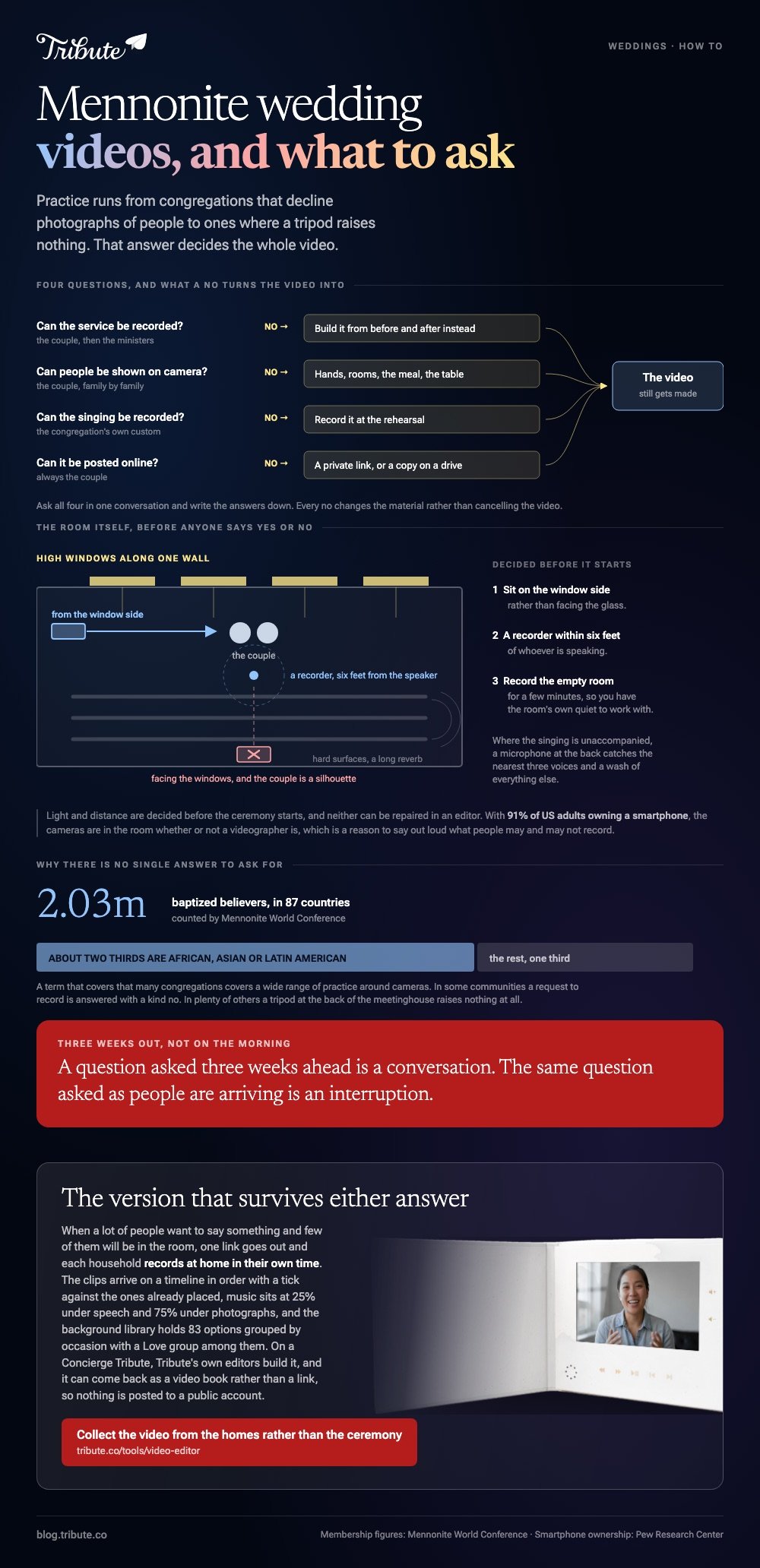
Ask the couple and the congregation first. Mennonite practice runs from congregations that decline photographs of people to congregations where a videographer is unremarkable, and that answer decides whether you record the service or build the video around it.
What makes Mennonite wedding videos different from other wedding videos?
There is no single Mennonite answer, which is the most useful thing to know.
Mennonite World Conference counts 2.03 million baptized believers in 87 countries, and says about two thirds of them are African, Asian or Latin American. A term that covers that many congregations covers a wide range of practice around cameras.
In some conservative communities, photographs and video of people are declined, and a request to record will be answered with a kind no. In plenty of other congregations a tripod at the back of the meetinghouse raises nothing at all.
| Ask | Who answers it | What changes if the answer is no |
|---|---|---|
| Can the service be recorded? | The couple, then the ministers | The video is built from before and after |
| Can people be shown on camera? | The couple, per family | Hands, rooms, the meal, the table |
| Can the singing be recorded? | The congregation's own custom | Record it at the rehearsal instead |
| Can it be posted online? | Always the couple | Send a private link, or a physical copy |
Ask all four in one conversation and write the answers down. Compared with asking on the morning, a question asked three weeks out is a conversation rather than an interruption.
Can you record inside the meetinghouse?
Sometimes, and the conditions matter more than the permission.
A meetinghouse is often a plain room with hard surfaces, high windows and no sound system. That gives you bright backlight behind the couple and a long reverb on every word, which are the two hardest things to fix afterward.
Three choices fix most of it.
Sit the camera on the window side rather than facing the windows, place a phone or a recorder within six feet of whoever speaks, and record a few minutes of the empty room so you have the room's own quiet to work with.
Where the singing is unaccompanied and congregational, a microphone at the back captures the nearest three voices and a wash of everything else.
Put the recorder in the middle of the room if you can, or accept that the singing is atmosphere rather than a feature.
Best for: A congregation that has said yes and a service you can sit through once beforehand.
Why it works: Light and distance are decided before the ceremony starts, and neither can be repaired in an editor.
How are Mennonite wedding videos made when cameras stay out of the service?
You build the video from everything that is not the ceremony.
This is the version worth planning for, because it survives either answer. Nothing in it depends on being inside the service, and it ends up more personal than a recording of a ceremony nobody can hear.
- Messages. Ask ten people for forty seconds each, recorded at home on their own phones.
- The preparation. Food being made, the room being set, tables being carried in.
- The meal. Where permission is often broader than it is for the service itself.
- Hands and rooms. Where a family would rather not be shown on camera, the work they did shows instead.
- A reading. Record the couple's chosen passage with one person, in a quiet room, afterward.
Smartphone ownership sits at 91% of US adults, per Pew Research Center, so the cameras are already in the room whether or not a videographer is. That is a reason to say out loud what people may and may not record.
Best for: Any wedding where the answer on recording the ceremony is no, or is not yours to get.
Why it works: The parts people rewatch are the ones where somebody says something, and none of those happen during the vows.

What about a wedding anniversary video instead?
Same method, more material, and no permission question during a service.
Wedding anniversary video making follows the steps above with one change: the couple has twenty-five or fifty years of photographs, and the people recording messages have stories rather than good wishes. Ask for the story, not the wish.
The wedding anniversary video ideas that work are the narrow ones. One question asked of twelve people produces a video with a shape: how did they meet you, what did their kitchen smell like, what did they teach you to do.
Keep the running time honest. A wedding anniversary short video of two to three minutes suits a meal where people are standing and talking, and a longer one belongs at home on a sofa with the family.
More on building either in making an anniversary video and what a video tribute is.
How do you put the clips together?
Use whatever is already on the machine holding the files.
On an iPhone, iMovie is a free app and handles a dozen clips without strain. Apple's guide to creating a movie project documents the flow.
- Open iMovie, tap Start New Project, then Movie.
- Tap each clip and photograph in the order you want it watched, then tap Create Movie.
- Tap a clip and drag its yellow edge in so it starts on the first word.
- Tap the audio tab, add a soundtrack, then lower the music bar so speech sits in front.
- Tap Done, then Share, then Save Video.
In a browser, Clipchamp does the same job on a Windows laptop.
Drag your files into My media, drag them onto the timeline, trim each clip with the green bars at its edges, add a track from the content library, then use the export button at the top right.
Best for: Twelve clips or fewer, gathered by one person who has an evening.
Why it works: Neither tool asks you to learn anything you will not use again, and both export a file you can hand over on a drive.
What if the messages came from thirty different households?
Then collecting is the job, and the editing is an hour at the end of it.
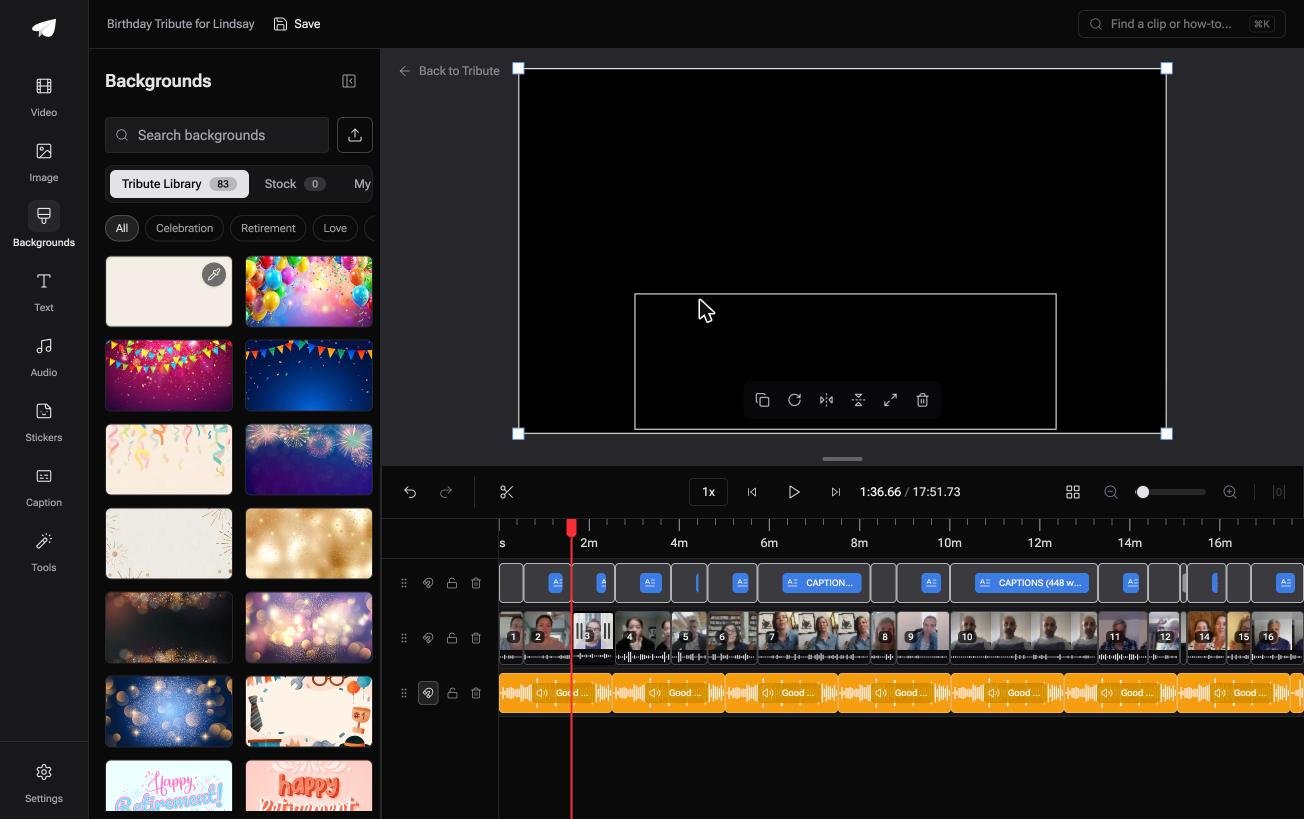
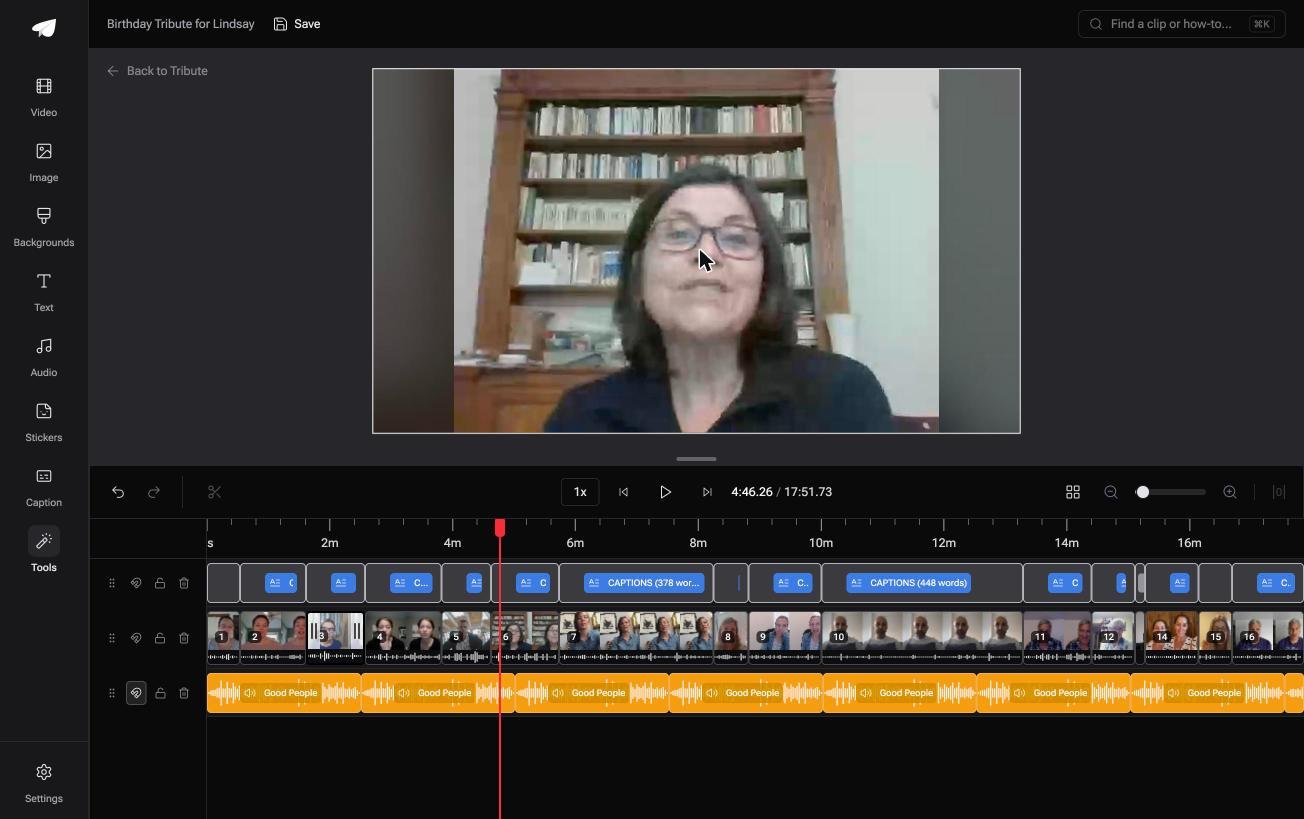
The Tribute video editor is a browser-based group video editor: contributors record clips on their phones and Tribute assembles them on a timeline with the music balanced under the voices.
The clips are in order before you open it, with a tick against the ones already on the timeline.
Specific numbers do the persuading. Music sits at 25% under a speaking clip and 75% under photographs, there are 39 licensed tracks across eleven genres, and 83 occasion backgrounds grouped by occasion, including a Love group for a wedding or an anniversary.
Best for: A wedding or anniversary video where twenty or more people each record a message at home.
Why it works: Nobody needs an account on a camera they do not own, and no clip has to be mailed on a drive.
Can the whole video happen without a camera at the wedding?
Yes, and it is the version that survives any answer about recording the service.
Everything above assumes one person is gathering files from thirty households and then assembling them. That gathering is where these projects die.
The case: several people, each recording for one couple
You are in it when the congregation is large, the family is spread across three states, and the parts worth keeping are things people say rather than things that happen at the front of a room.
Which means the question that brought you here, how Mennonite wedding videos get made, has a version that never goes near the ceremony. Nobody records the service because nobody needs to.
What you do not have to do
Three things, and asking permission to record a ceremony is the first of them.
- No gathering. One link, and each household records at home in their own time.
- No ordering. The clips arrive on a timeline, music at 25% under speech.
- No edit, if you would rather not. On a Concierge Tribute, Tribute's own editors build the video and hand it back.
That is how the Tribute video editor handles it. Unlike a shared folder that fills up over six weeks, there is no point where you are matching thirty filenames to thirty families.
Where it ends up
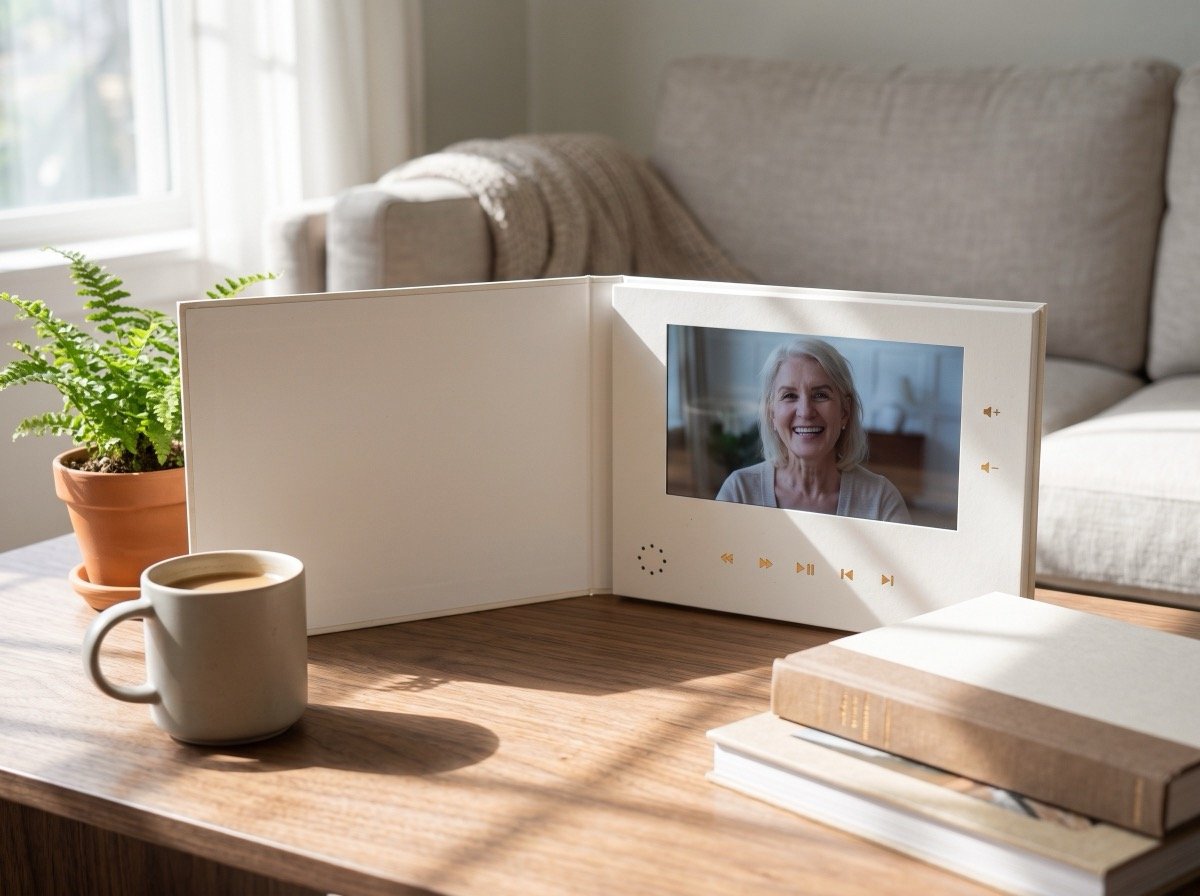
The finished video can arrive as a video book: a hardcover case with a screen inside that plays when you open it.
For a household that would rather not post anything online, that matters more than it sounds. Nothing is uploaded to a public account and nothing is passed round on a phone.
When this is the wrong answer: the couple wants the ceremony itself recorded, or the community declines video of people in any form. In the first case hire someone local who has worked in that meetinghouse.
In the second, a written book of the same messages does the same job. The wider how-to is in our main montage guide.
Frequently Asked Questions
Is it rude to ask whether a wedding can be recorded?
No, and asking is the respectful version. The rude move is arriving with a camera and finding out during the service that the answer was no.
Who decides, the couple or the church?
Start with the couple, because it is their day and they know their families. They will tell you whether the ministers need asking as well.
Can I share the video online afterward?
Only with permission, and ask per family rather than once. An unlisted link is the usual compromise, since it stays out of search and opens without an account.
What length works for a wedding video?
Six to ten minutes for a video built from messages, and three to five for one shown at a meal. Past ten minutes people start watching the room instead of the screen.
What music should go under it?
One instrumental track from a licensed library, kept low under the voices. Where the community sings unaccompanied, a recording of that singing is a better bed than anything from a library.
How far ahead should I start collecting?
Three weeks for ten households, five for thirty. The last five take as long as the first twenty-five, every time.
What if an older relative cannot record on a phone?
Sit with them and hold the phone yourself, or take a voice recording and put it over a photograph. The sentence is the part that matters, not the picture of them saying it.
👉 Collect the wedding video from the homes rather than the ceremony if a lot of people want to say something and few will be in the room.
