
Music for Graduation Slideshow: What to Pick, and How to Clear It
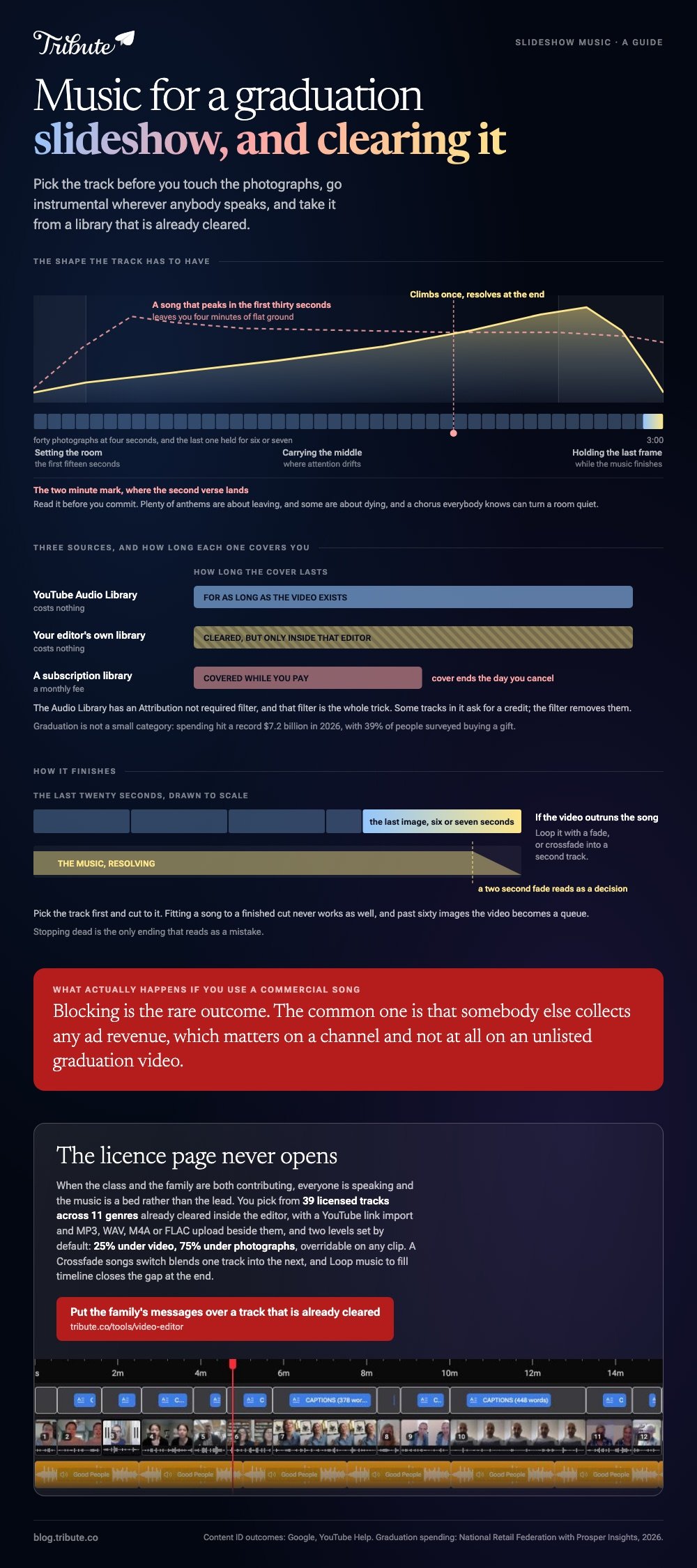
Pick the track before you touch the photographs, choose something without lyrics if anyone speaks on camera, and take it from a library that is already cleared. Three minutes carries about forty photographs.

What counts as good music for graduation slideshow projects?
A track that climbs once and resolves at the end.
Think of a graduation slideshow as a shape rather than a playlist. It opens on baby photographs, moves through school years, and lands on one image of the person as they are now.
The song has to do the same thing. Anything that peaks in the first thirty seconds leaves you four minutes of flat ground.
Three jobs the track is doing
- Setting the room. The first fifteen seconds tell a hall of parents what kind of video this is.
- Carrying the middle. Years four through twelve are the stretch where attention drifts.
- Holding the last frame. The final photograph should sit on screen while the music finishes.
The lyric trap
Plenty of anthems are about leaving, and some are about dying.
Read the second verse before you commit. A song everybody knows the chorus of can turn a room quiet for the wrong reason at the two minute mark.
Where a graduate, a parent or a teacher speaks on camera, go instrumental for that stretch. Words and words compete, and the speech loses.
Title suggestions are in the best songs for a graduation slideshow.
Where do you get music for graduation slideshow use without a copyright claim?
Three sources cover almost everyone, and two of them cost nothing.
| Source | Cost | The catch |
|---|---|---|
| YouTube Audio Library | Nothing | Some tracks need a credit |
| Your editor's own library | Nothing | Cleared only inside that editor |
| A subscription library | A monthly fee | Cover ends if you cancel |
The YouTube Audio Library sits inside YouTube Studio, and you can filter it down to tracks where attribution is not required. That filter is the whole trick.
Editors ship cleared music too. iMovie, CapCut, Clipchamp and Canva each carry a catalog licensed for use inside them. Compared to a search of the open web, a shelf of forty tracks settles the question before you start.
Best for: A video going on YouTube, a school site, or anywhere with an audience past the family.
Why it works: Clearance is decided at the moment you pick the track, which is the one moment where swapping costs nothing.
What happens if you use a commercial song anyway?
It depends on where the video is going, and nothing else.
Played once on a projector in a school hall, a commercial song is a question for the school rather than for you. Uploaded, it meets Content ID, and YouTube documents three outcomes: the video is monetized for the owner, tracked, or blocked.
Blocking is the rare one. The common result is that someone else collects any ad revenue, which matters on a channel and not at all on an unlisted graduation video.
Unlike a claim, a swap costs nothing early and everything late. Change the track before you cut forty photographs to its beats.
How long should the slideshow run, and how many photographs?
Divide the song, then cut the photo count until it fits.
Four seconds a photograph is the working number. Three minutes carries about forty, and past sixty images the video becomes a queue.
- Pick the track first and cut to it. Fitting a song to a finished cut never works as well.
- Let the last image hold for six or seven seconds while the music resolves.
- Fade out rather than stopping dead. A two second fade reads as a decision.
- Loop with a fade if the video outruns the song, or crossfade into a second track.
Graduation gifts are not a small category: the National Retail Federation's 2026 survey, run with Prosper Insights, puts spending at a record $7.2 billion, with 39% of respondents buying a gift. A video is the one that gets watched twice.
How loud should the music sit under a voice?
Lower than feels right in the room you are editing in.
Library music is mastered to sound good on its own, which means it will bury a sentence recorded on a phone at the back of a gym.
| Underneath | About |
|---|---|
| Someone talking | A quarter of full volume |
| Photographs, no voice | Three quarters |
Set the level per clip rather than once for the project. Music for a graduation video that mixes speeches with stills needs two levels, not an average of them.
More on the mechanics is in slideshow makers with music and the best app for a slideshow with music.
Where does a video of family messages get made?
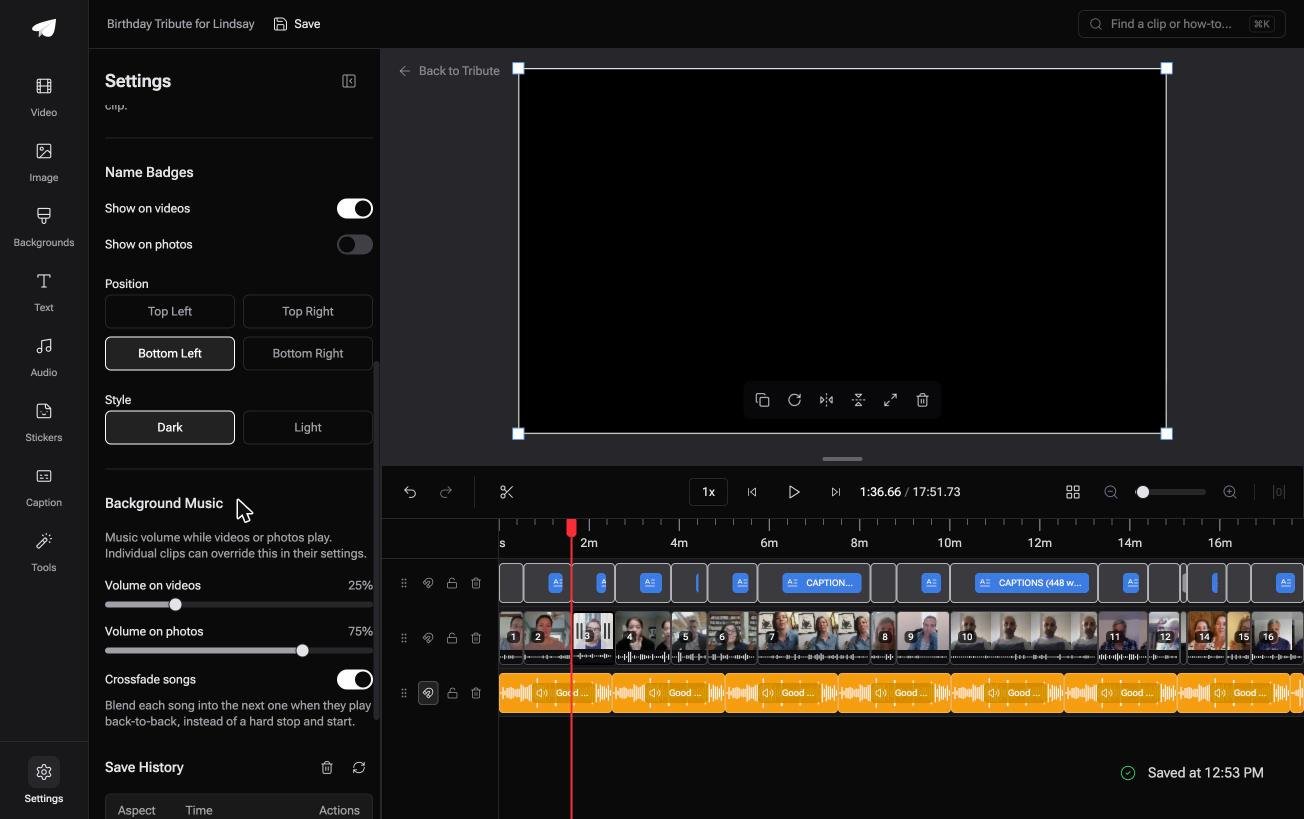
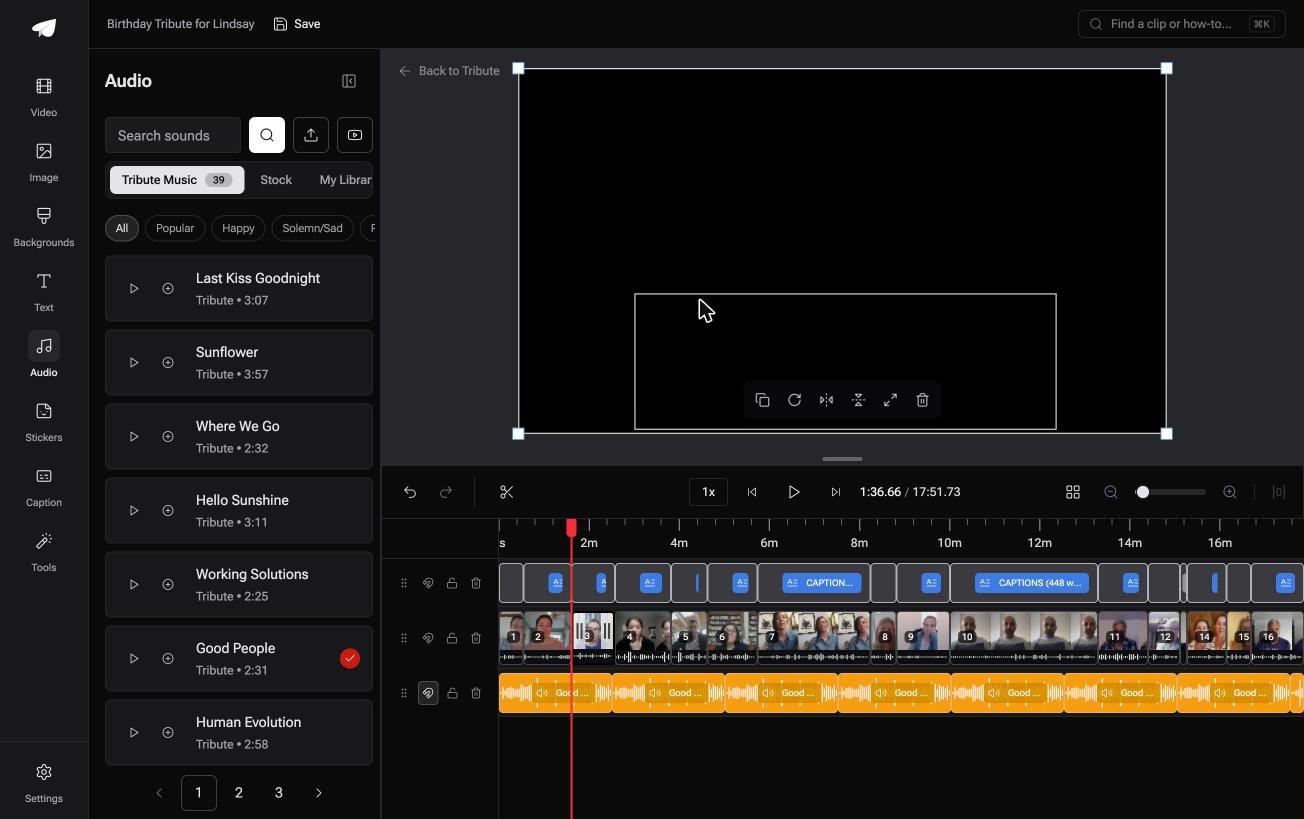
The Tribute video editor is a browser-based group video editor: contributors record clips on their phones and Tribute assembles them on a timeline with the music balanced under the voices.
It is ours, and it is the last thing on this page.
- 39 licensed tracks across 11 genres, plus a YouTube link import and MP3, WAV, M4A or FLAC upload
- 25% under video and 75% under photos by default, overridable on any single clip
- A Crossfade songs switch blends one track into the next when the video outlasts a song
- Loop music to fill timeline in the Tools panel, for the gap at the end
- 83 occasion backgrounds grouped by occasion, including a graduation set
Best for: A graduation video where grandparents, coaches and old teachers each send a message.
Why it works: Two music levels, one for speech and one for stills, are the default rather than a setting somebody has to find.
What if the song were cleared before you picked it?
The whole page above is the price of choosing from everything.
You searched, read a license, checked whether a credit was compulsory, then worried about a claim on the upload.
There is one case where nobody pays it.
The case: the class and the family are both contributing
You are in it when the video is messages, not footage.
A grandmother who could not travel. A coach of six years. Three friends who moved away in tenth grade and still want to say something.
Nobody is scoring a video here. Everyone is speaking, and the music is a bed, not the lead.
Why the clearing question never arises
A cleared shelf is a much smaller problem than an open web.
When the music lives inside the tool that assembles the video, the license is settled before you arrive. You pick from thirty-nine tracks already cleared for it, and the level under each voice is set.
That is how the Tribute video editor handles it: not a fourth source for the table above, but a way of never opening it.
When this is the wrong answer: the slideshow is your own photographs and one song, or the school has asked for a specific commercial track. Then go back to the sources above. The editor runs in a browser and lives inside a paid Tribute.
The wider craft is in making a video montage.
Frequently Asked Questions
Can I use a popular song in a graduation slideshow shown at school?
A one-off showing in a hall is a question for the school's own licensing, not something you settle from a laptop. Ask the office before the night, because the answer changes nothing about the edit if you ask early.
What is the safest music for a graduation video going on YouTube?
Either a YouTube Audio Library track filtered to attribution not required, or the cleared library inside your editor. Both remove the claim before it can happen.
How many songs should a graduation slideshow use?
One for anything under four minutes. Past that, two tracks with a crossfade between them hold attention better than one song looping.
Should the music have lyrics?
Instrumental wherever anyone speaks on camera. Lyrics are fine over photographs on their own, and they are the fastest way to lose a spoken message underneath them.
How do I stop the music drowning out a speech?
Set the level on that clip alone, at about a quarter of full volume, and lift it back up over the silent stretches. A single level for the whole timeline buries the quietest speaker.
What tempo works for a graduation slideshow?
Something you can change photographs on without rushing, which in practice means a track that leaves room at four seconds an image. A fast song pushes the cut rate past what anyone can read.
Do I have to credit the artist?
Only when the license says so, and it will say so in plain words. Creative Commons BY always asks for it, some YouTube Audio Library tracks do, and most paid libraries do not.
👉 Put the whole family's messages over a track that is already cleared if everyone is recording for one graduate, and the license page never opens.
